Facebook IPO
- Started
- Last post
- 361 Responses
- utopian0
7 Reasons Why Facebook IPO Was A Bust
1. Too late. Facebook‘s shares have been dead in the water for the last 12 months. Private investors had already bid up Facebook to a $100 billion value a year ago.
2. Mark Zuckerberg’s disdain for investors. He never wanted to be a public company. This became all too obvious during the IPO road show’s crucial stop in New York when (a) Zuck hid out in the bathroom and forced the audience to wait, and (b) he took the stage wearing his hoodie. Zuckerberg’s view of shareholders is like President Obama’s view of blue collar workers. He needs them but secretly laughs at them.
3. Facebook left nothing for the common investor. The insider pig pile of PE firms and celebrity Silicon Valley angels took it all. This is a rather new, post-Sarbanes-Oxley fact and it should make Americans very, very angry. When Microsoft when public in 1986, its market value was $780 million. Microsoft’s market value would rise more than 700 times in the next 13 years. Bill Gates made millionaires of thousands of ordinary public investors. When Google went public in 2004 at a $23 billion valuation, it left less on the table for you and me. Still, if you had invested in Google then and held your stock, you would be sitting atop a 9x return. Zuckerberg and his Facebook friends took it all.
4. Europe and May. Facebook’s shares debuted in a cloudy market. Beyond Europe in 2012, May is a bad time to go public. For the past several decades, nearly all of the stock market’s gains have occurred between October and May. The canard “Sell in May and go away” turns out to be true.
5. Facebook boredom, particularly among professionals. The company says it is zeroing in on a billion members. Good for Facebook, but what I would like to know is how many Facebook users have grown bored. I have not visited my Facebook page in two months. Almost every professional person I talk to who is over 25 years old has grown bored with Facebook.
6. Facebook is not necessary. Investing in tech companies is never easy. The great Warren Buffett eschews it. The key question about tech companies is not P/E values, but necessity. I like Google, Intel, Cisco, IBM, Oracle, EMC and SAP because the world’s economy depends on them. Sure, we could live without them, but not without major disruption. The switching costs would be extremely high. (I like Apple for an altogether different reason — the 80-20 rule; 20% of customers in any field will pay top dollar for a great product. Apple may be more of a luxury than it is integral to the global economy, but Apple monopolizes the luxury category.) Facebook is not integral to the global economy and its cool brand is rapidly fading.
7. Mass social media is a crock. It is an inherent contradiction. This is why I like LinkedIn more than Facebook. It has a special purpose and therefore doesn’t feel like a time waster. FWIW, I predict the next huge win in social media will be in health care. As a health care consumer, I want to chat with people who are just like me. With similar gene structures. Who suffer from similar maladies as well as the genetic potential for similar maladies. When linking up with my “health friends” I also want a 100% guarantee that my social network won’t betray my health confidences. Would I trust Facebook to keep these confidences? Never.
- did you write this?monospaced
- why yes, yes I did!utopian
- Obama secretly laughs at blue collar workers?Josev
- Have you ever seen blue-collar comedy? I'd laugh too!CanHasQBN
- utopian0
Sup monospaced?
- monospaced0
This whole IPO is going to change the Facebook experience. As utopian wrote above, Mark never wanted to go public. I don't think he ever even imagined Facebook making him a billionaire. I think he just wanted to make an impact on social networking, something that people would use and enjoy. I don't think he imagined Facebook focusing on revenue streams and answering to shareholders.
Now, with Facebook gone public, they will have to answer to shareholders in a whole new way. Revenue will be scrutinized. Facebook will be forced to further monetize its product and the impact will be clear to most users. It's just a matter of time before it's even more ad-riddled.
- I give Facebook 24 months before it ends up worst than Myspace.utopian
- wordmonospaced
- utopian0
Facebook IPO investor sues Nasdaq over trading delays
http://news.cnet.com/8301-1023_3…
- 20020
"Now, with Facebook gone public, they will have to answer to shareholders in a whole new way. "
WRONG
Zuck owns over 50% of the voting shares. He purposely did this so he wont need to listen to the share holders.
- correct, but are you saying there won't be increased pressure from public shareholders?monospaced
- 20020
They can scream, yell and sue all they want. It does not matter. If a company was controlled by public opinion, it would quickly fail.
Shareholders are essentially suing because they expected to make boat load of money off the IPO pop. They didnt get it. They are looking for excuse to make that money. Morgan Stanley did their job of valuing company to its fullest by giving $38 per share to Facebook.
Not sure if you guys understand how IPO works.
- And do you understand that shareholders buy shares to make money? "Looking for an excuse..."?Josev
- utopian0
Unfriendly Fire: Shareholders Sue Facebook, Morgan Stanley
http://www.foxbusiness.com/techn…
- monospaced0
@2002 I wasn't even addressing the shareholders suing over the IPO. I understand perfectly how the IPO works and Mark's percentage of ownership. What I'm trying to say is that, now that they're public, the general public will be focusing on their revenue. No, a company isn't controlled by public opinion, but buying and selling of a stock often is. You're also right about shareholders looking for an excuse to make money, and those very shareholders will expect Facebook to monetize further. Whether they do or not is, as you pointed out, Zuck's decision ultimately, I personally think the pressure from public will weigh heavy on the decisions made moving forward. Especially with the stock price at the mercy of investors.
- 20020
"perfectly how the IPO works "
Explain it.
- no, YOU explain itmonospaced
- you said you understand it but I dont think you do.2002
- it's a standard public offering... I've moved on many beforemonospaced
- Facebook is cashing in.monospaced
- and what is that? you just spelled out the PO.. didnt explain it.2002
- ok... INITIAL. They are selling stock for the first time. What else do you need me to say to prove it?monospaced
- I'm not stupid.monospaced
- I disagree.2002
- you could have just wiki IPO and tried to look like you know stuff.2002
- I could have. And after you suggested it I did and it's pretty simple and spot on.monospaced
- utopian0
Here is how an IPO works.
1. Have the largest and most powerful banks in the world underwrite IPO.
2. Hype-up and over-inflate the true value of company.
3. Share confidential information about the IPO with a select few of elite bankers just before the stock goes public (aka) insider information.
4. days, hours and or minutes before IPO goes public, concealed a weakened growth forecast prior to the high-profile IPO.
5. Begin Short Hedge: bet against and hedge against potential losses in an investment that is held long, offset by losses in the derivatives position, and vice versa.
6. Make millions and billions of dollars, then dump the super inflated stock to the bottom feeding working class citizens trying to get a sliver of the American Pie.
7. Watch stock go into tank, buy an island or two
8. Laugh at the regulators and inept regulations, in a fraudulent deregulated financial system
9. Make millions and billions in bonuses and incentives
10. Repeat Steps 1-9
- utopian0
Definition of 'Short Hedge'
An investment strategy that is focused on mitigating a risk that has already been taken. The "short" portion of the term refers to the act of shorting a security, usually a derivatives contract, that hedges against potential losses in an investment that is held long.If a short hedge is executed well, gains from the long position will be offset by losses in the derivatives position, and vice versa.
Investopedia explains 'Short Hedge'
A common risk in short hedging is basis risk, or the risk that price levels will not change much over the period the hedge is in place; in this scenario, the asset held in the long position would not gain any value, and the short hedge would lose value.Short hedging is often seen in the agriculture business, as producers are often willing to pay a small premium to lock in a preferred rate of sale in the future. Also, short hedges involving interest rates are common among institutional money managers that hold large amounts of fixed income securities and are concerned about reinvestment risk in the future.
- 20020
Don't forget to add that your 401k is made and held by the elites with insider info
- is it true Bloomberg records your keystrokes if you work there?monospaced
- I dont know, do they?2002
- utopian0

Oh, Zuck: Facebook's bumpy start just got a little worse!
To say its been a rough ride for Facebook's IPO would be an understatement.
And as the social media giant edges toward the close of its first week of trading, questions are swirling about the company's valuation, its profitability and now allegations that full details of the stock's likely value were shared with only a select group of people.
- robotron3k0
On May 18, 2012 beginning at 11:29:52 and continuing for almost 17 seconds until 11:30:09, quotes and trades from reporting exchange Nasdaq for all NYSE, AMEX, ARCA, and Nasdaq listed stocks completely stopped. In exchange-speak, 17 seconds is 17,000,000 microseconds - an eternity by HFT standards.
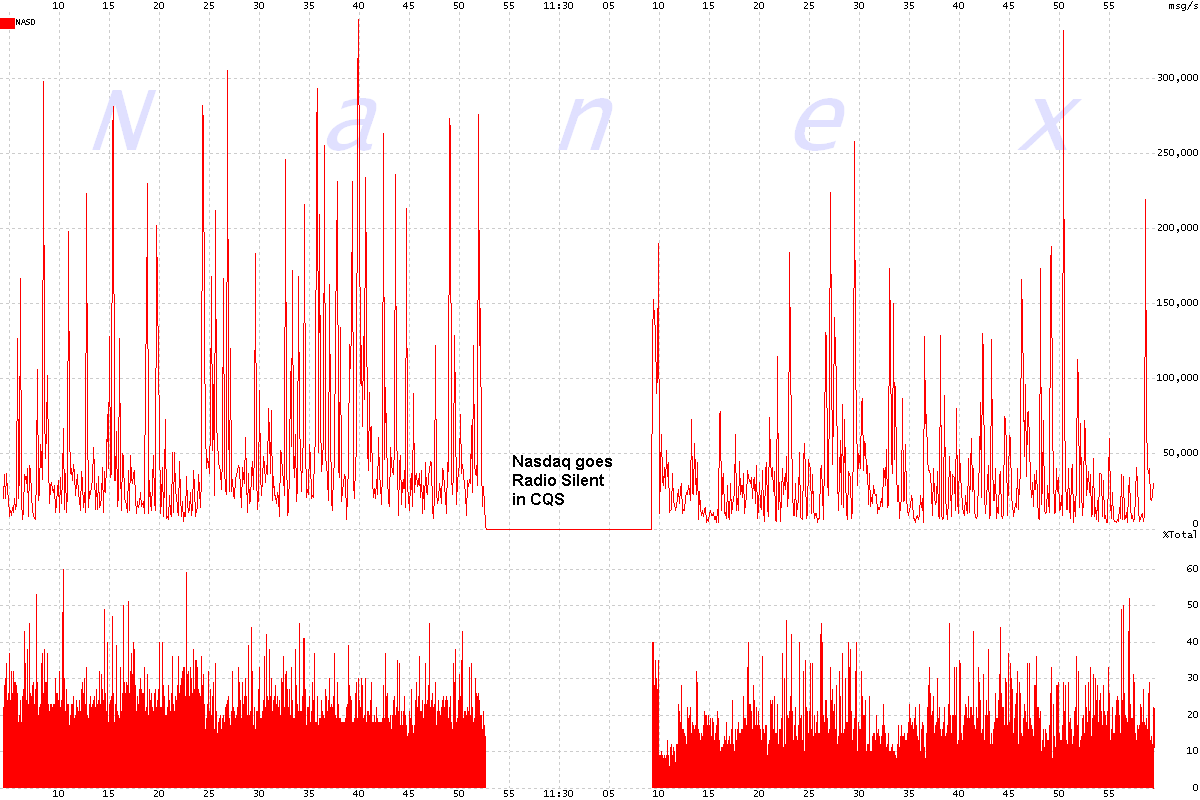
investigations should begin soon...
- 17 seconds, wasn't that a hard core band??robotron3k
- 7 SecondsKnuckleberry
- albums0
The only way to make money is to take money.
- pinkfloyd0
Speaking of investing, why does Greece always seem to show it's crisis during the summer for the past 3 years yet it's ignored during the fall and winter? The Euro crisis always seems to appear during the summer.

